What 47 Pesos Gets You in San Miguel de Allende (Spoiler: More Than $47 in Austin)
I walked into the grocery store with 50 pesos in my pocket — about $2.50 in real money — and came out with enough food for dinner. Not ramen. Not a sad desk salad. An actual meal for three people. This is the kind of math that makes your old life feel like a fever dream. Let me break down exactly what 47 pesos bought me at the local Soriana yesterday: two pounds of chicken thighs (22 pesos), three Roma tomatoes (4 pesos), one white onion (3 pesos), a bunch of cilantro (5 pesos), two limes (2 p

I walked into the grocery store with 50 pesos in my pocket — about $2.50 in real money — and came out with enough food for dinner. Not ramen. Not a sad desk salad. An actual meal for three people.
This is the kind of math that makes your old life feel like a fever dream.
Let me break down exactly what 47 pesos bought me at the local Soriana yesterday: two pounds of chicken thighs (22 pesos), three Roma tomatoes (4 pesos), one white onion (3 pesos), a bunch of cilantro (5 pesos), two limes (2 pesos), a head of lettuce (8 pesos), and a small bag of tortilla chips (3 pesos). Total: 47 pesos, or $2.35.
In Austin, that same chicken would run me $8. The tomatoes, another $4. The onion, $2. We're already at $14 and I haven't even started on the cilantro that costs more than my rent used to.
Okay, that's hyperbole. But barely.
The Real Exchange Rate
The peso-to-dollar conversion is just arithmetic. The real exchange rate is what that money buys you in terms of life. And in San Miguel, 47 pesos doesn't just buy dinner — it buys the kind of dinner that makes you remember why you moved here.
Last week, I paid 35 pesos for a haircut. The barber — Miguel, same name as half the men in this town — spent forty minutes on it. Talked about his son's upcoming quinceañera, asked about my family, gave me the kind of attention that used to cost me $60 in Austin and fifteen minutes of awkward silence.
My son's math tutoring runs 200 pesos per session. That's ten dollars for an hour with a retired engineering professor who speaks perfect English and makes calculus less terrifying than it was when I was seventeen. In Austin, we were paying $75 an hour for someone who checked their phone during lessons.
Coffee Shop Economics
The café where I write most mornings charges 28 pesos for an Americano. That's $1.40 for coffee that would cost me $4.50 at the place I used to frequent near my old office. But here's the thing — it's not just cheaper coffee. It's better coffee, served by someone who remembers how I like it, in a space where nobody's rushing me to order or leave.
I spent three hours there yesterday, nursing two coffees and working on a client project. Total tab: 56 pesos. In Austin, the parking alone would have cost more.
The economics get absurd when you scale up. My wife's yoga classes cost 120 pesos each — six dollars for an hour with an instructor who trained in India and teaches in a studio overlooking the mountains. Our old yoga membership in Austin ran $180 a month for classes in a strip mall next to a Subway.
Housing Math That Breaks Your Brain
Our rent here is 18,000 pesos a month for a three-bedroom house with a rooftop terrace and a view of the Parroquia. That's roughly $900. Our mortgage payment in Austin was $2,800 for a house where the biggest view was of our neighbor's fence.
Utilities tell the same story. Our electric bill last month was 340 pesos — seventeen dollars. In Austin, keeping that house cool in August cost us $350. Here, we don't run air conditioning because we don't need it. The altitude and the colonial architecture do what central air used to do, and the cost is measured in open windows, not kilowatt hours.
The Things That Cost More
Not everything is cheaper. Electronics cost more — sometimes significantly more. My laptop charger died last month and replacing it cost 1,800 pesos instead of the $50 it would have been on Amazon. Imported anything carries a premium that makes you appreciate what's made locally.
Car maintenance runs about the same, maybe slightly less. But since I walk to most places now, the car sits in the garage more than it moves. My gas bill last month was 600 pesos — thirty dollars. In Austin, I was filling up twice a week.
What 47 Pesos Really Buys
That chicken and vegetables turned into tacos. We ate them on the rooftop, watching the sun set behind the mountains, listening to the church bells that have been ringing the hours since before my country existed.
In Austin, $47 might have bought us takeout from the Thai place. We would have eaten it in front of the TV, scrolling through phones, trying to decompress from jobs that demanded everything and gave back spreadsheets.
The peso goes further here, but that's not the real story. The real story is that life costs less when you need less. When your entertainment is a sunset instead of a streaming service. When your gym is the cobblestone hills instead of a membership you never use. When your social life happens in plazas instead of restaurants that charge $18 for a cocktail.
The Invisible Costs
There are costs that don't show up in peso calculations. Learning to navigate bureaucracy in a second language. Missing your nephew's birthday party. Explaining to your mother why WhatsApp video calls are not the same as being there.
But there are invisible savings, too. My stress level costs me nothing here. My commute is a ten-minute walk through colonial streets instead of an hour in traffic. My schedule belongs to me, not to conference calls scheduled by people who never learned to account for time zones.
Yesterday, those 47 pesos fed my family dinner. But they also bought me the reminder that the life I was working toward in Austin — the one where I could afford anything — was less satisfying than the life I'm living now, where I can afford what matters.
The math isn't just about money. It's about what money buys you in terms of time, stress, and the kind of Tuesday evening where you eat tacos on a rooftop and remember why you left everything familiar behind.
Some people move to Mexico for the cheap cost of living. I moved here for the expensive cost of the alternative.
If this resonated, The Dispatch goes deeper every week. More numbers, more stories, no spam.
More Dispatches
Why I Ignored the 4% Rule (And Retired at 43 Anyway)
The 4% rule is gospel in early retirement circles. Pull 4% from your nest egg annually, the orthodoxy goes, and your money will last forever. Or at least thirty years, which is close enough for most spreadsheets. I ignored it completely. Not because I'm reckless with money — quite the opposite. I spent fifteen years as a corporate finance guy, building models that predicted quarterly earnings to the penny. I know how math works. I also know how life works, and life doesn't follow withdrawal ra
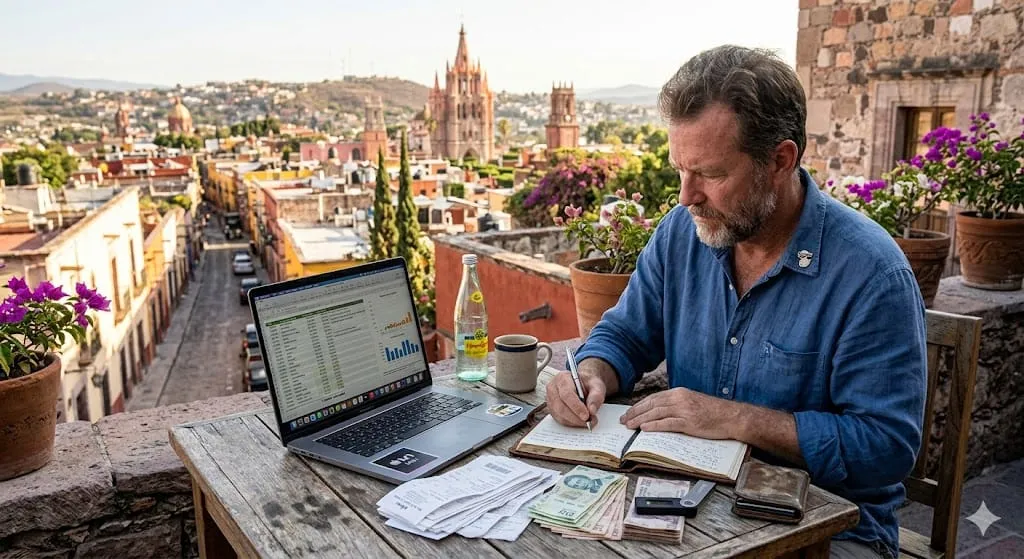
I Spent 18 Months Tracking Every Peso in San Miguel: Here's What $1,800 Actually Gets You
My spreadsheet has 547 rows. Eighteen months of tracking every peso spent in San Miguel de Allende, from the fifty-peso tip to the woman who waters our plants to the 28,000-peso quarterly property tax bill. Every café cortado, every Uber to the doctor, every bottle of mezcal bought for friends who visit from the States. Why track it all? Because "Mexico is cheap" tells you nothing. Because expat Facebook groups are full of people arguing whether you need $1,200 or $3,000 per month, and nobody